Summary
- Technological conditions can affect the collective consciousness.
- Technology trigger important changes in cultural development.
- Walter Benjamin's essay 'The work of art in the age of mechanical reproduction' (1936) significantly evaluates the role of technology through photography as an instrument of change.
- We were asked to draw a small doodle during the lecture, faithfully copy it and then do it again and again. The thing we learnt from this was that the copy and reproduction of the original was often more valuable than the original itself.
Walter Benjamin and mechanical reproduction:
- The age of technology and art.
- Parallel and specific to new developments; a duality expressing the zeitgeist.
- Dialectical due to the copy, reproductive nature and the role of the original.
- The aura abd uniqueness of art.
- Technology first started with the simple photograms.
- Kineticism was another turning point for the evolution of technology.
- Dematerialization of art.
Karl Marx and technology:
- Associated with the term technological determinism. How technological determines economical production factors and affects social conditions.
- The relationship of technological enterprise to other aspects of human activity.
Dialectical issues:
- Technology drives history.
- Technology and the division of labour.
- Materialist view of history.
- Technology and Capitalism and production.
- Social Alienation of people form aspects of their human nature as a result of capitalism.
Post modern Post machine:
- Many electronic works were still made with modern aesthetic.
- Emergence of information and conceptual based works.
- The computer a natural metaphor.
- A spirit of openness to industrial techniques.
- Collaborations between art and science.
Simulation and Simulacrum:
- It is the reflection of a profound reality.
- It masks and denatures a profound reality.
- It masks the absence of a profound reality.
- It has no relation to any reality whatsoever; it is its own pure simulacrum.
- Jean Baudrillard (1981).
- Nam June Paik: He used technologies as a critique on their actual affect on society.
- John Walker and art and mass media: Art in the age of mass media (2001)
- Art uses mass media (1990-2000)
- Art in advertisements
- The artist as media celebrity
- Digital age//
- Margot Lovejoy; Digital currents
- Digital potential leads to multimedia productions.
- Technological reduction of all images so they are addressed by the computer.
- New contexts.
Multimedia work:
- Interactivity
- Performance
- Transdisciplinary
- Time, space and motion explored in art and as art
- Collaborations
- Computer as a tool for integrating media
- Hyperreal; reality by proxy
- Conclusion:
- Art comments on the ideology of everyday life.
- Art can be expressive and progressive.
- Technological tools can blur the line between production of fine art works and commercial and design production.

Sunday, 23 October 2011

Panopticism// Study task 1..
Portfolio task one:
Choose an example of one aspect of contemporary culture, that is, in your opinion, panoptic. Write an explanation of this (200-300 words) employing key Foucauldian language such as 'docile bodies' or 'self regulation' and using no less than 5 qoutes from the text 'Panopticism' in Thomas J, (2000), ' Reading key images, NY, Paulgrave McMilan.
---------------
One aspect of contemporary culture that uses panopticism to control people is CCTV. CCTV is placed almost everywhere nowadays, most of the time we know where the cameras are placed but some can also be hidden. The ones that are on show are placed in obvious places and often with signage to let us know we are being watched. This means that we behave in a particular way that society wants us to act, the right behaviour. ' Benthan laid down the principle that power should be visible and unverifiable', this is the case with some CCTV cameras that are not actually turned on, they are there as a symbol of power to remind us of those who have control over us.
The CCTV cameras are panoptic because they make us conscious of how we act and makes us believe that one way or another, we are being watched. Its much like the Panopticon, with the central guard tower watching over prisoners, but in actual fact there were no guards in the tower, the tower itself had the power to conciously change the behaviour of the prisoners. ' Hence the major effect of the Panopticon: to induce in the inmate a state of conscious and permanent visibility that assures the automatic functioning of power..the surveillance is permanent in its effects, even if it is discontinuous in its actions..'. You no longer need cameras that actually watch people because they believe they are being watched anyway. Foucault talks about how we begin to self regulate and behave correctly as we 'know' we are being constantly watched. It is all to do with how the mind works and how we can control ourselves, without the pyhsical use control of others.
CCTV watches everyone, in a way it is not such a powerful thing because even those who are in charge and who have power can be watched. Much like the paparazzi and celebrities and how they use cameras, often CCTV and the pap get those in high places into trouble, because little do they know that they are being watched too. ' The Panopticon may even provide an apparatus for supervising its own mechanisms..the director may spy on all the employees that he has under his orders..'. The ones who watch are being watched and so on. CCTV is just a symbol of powerful status, and it is slightly crazy how a camera can control us, it is just a unanimus object.
' Visibility is a trap', we all believe that we have free will and we can do what we want but at the end of the day we no longer have control of our free will, yes we consciously make the decision to behave in a certain way but it is those symbols of power (CCTV for example) that determine our actions.
Often just the signs of CCTV alome are more powerful than the cameras themselves.
Friday, 14 October 2011
Lecture one// Panopticism..
Lecture aims:
- Undertstand the principles of the panopticism
- Understand Michel Foucault's concept of 'disciplinary society'
- Consider the idea that disciplinary society is a way of making individuals 'productive and useful'
- Undertsand Foucaults idea of techniques of the body and 'docile' bodies.
- Michel Foucault// 1926-1984
- Books// Madness and Civilisation, Discipline and Punish: The birth of the prison
- In the late 1600 The Great Confinement came to light, this was a seperation in society where criminals, unemployed and the insane were made social out casts. They began being punished for who they were and by this process were 'forced' to become more productive members of society.
- ' Houses of correction'// These were the first ever prisons built in the late 1600's, they were built to curb unemployment and idleness. Before now the insane for example led an easy life, they were simply seen as the village idiots or mad fools and belonged to society. But in the late 1600s societys attitude changed towards this particular group of people and they saw them as useless. Society began to have a moral attitude and those who fell outside of the normal, productive society were thrown into correction houses to bring them up to societys new mark. People within this group include criminals, lazy people, the insane and even single mothers, they were to put to work under the threat of being beaten if they did not get up to scratch.
- The houses of correction became a gross error, they ended up corrupting more people. This then became the birth of Asylum which seperated the sane from the insane, before ow there was no line drawn between the two within society.
- Places were built for asylums and the insane would be treated very differently, much like children. If they were good then they would recieve rewards. This was the turning of point of how outcasts in society would be disciplined. They realised there were other ways to control people, there then became a shift from physical control to mental control.
- Foucault talks about how instituitional power within places like the prison, asylum, hospitals and schools now effects humans in such a way that they alter our conciousness and that they internalise our responsibility.
- Years ago punishment would take the form of public humiliation, the outcasts would be placed in pillories and have food thrown at them as well as being spat on. Everyone would come and watch and know why those indivuals were in the stocks.
- Guy Falke's execution is a good example of how punishment used to work. It was done publically and the King decided on how he would be killed. The execution was brutal and a warning to anyone else who dared try and go against the 'system'.
- Disciplinary society and disciplinary power//
' Discipline is a 'technology' [aimed at] 'how to keep someone under surveillance, how to control his conduct, his behaviour, his aptitudes, how to improve his performance, multiply his capacities, how to put him where he is most useful: that is discipline in my sense'
(Foucault, 1981 in O'Farrell 2005:102)
- This was called Panopticism
- In 1971 a man named Jeremy Bentham designed a proposal for a building called The Panopticon. The Panopticon was a circular building that had hundreds of individual cells inside, each sell faced towards a large central tower. The cells each had a small window which backlit each cell. The central tower was a place for guards. The building would have been used as a prison and the prisoners would have been constantly watched from the central tower.
- There are modern Panopticon buildings built in Cuba called the Presidio Modelo. The Millbank prison in london also used the structure of the Panopticon.
- Because of the way in which the Panopticon was built around the central tower and how all the cells were facing it. Anyone kept inside a cell felt constantly watched by the guards which meant they would behave in such a way as to not get caught doing anything they shouldnt. The tower was known as the institiutional 'gaze'. The tower was never lit up and blinds were often used to enclose those inside, this would then make prisoners unaware on whether or not they were actually being watched. As the prisoners became more self controling over thier own behaviour simply because they thought they were constantly being watched. The tower started to be left empty, it now had its own pwerful status, guards were no longer needed to watch the prisoners because they had been set in a frame of mind that made them behave through the unknown knowledge of whether they were actually being watched or not.
- It got to the point that the cells no longer needed bars on them because prisoners had a conscious control over themselves, they had begun self disciplining themselves. The Panopticon had internalised the individuals conscious state that he is always being watched.
- Panopticism//
' Hence the major effect of the Panopticon: to induce in the inmate a state of conscious and permanent visibility that assures the automatic functioning of power.'
(Foucault, 1975)
- By using the Panopticon method on criminals and the insane it allowed scrutiny, allowed supervisors to experiment on subjects and it aimed to make them productive.
- It helped reform prisoners
- Helps treat patients
- Helps instruct school children
- Helps confine, but also study the insane
- Helps supervise workers
- Helps put beggars and idlers to work.
- What Foucault is describing is a transformation in Western societies from a form of power imposed by a 'ruler' or 'sovereign' to A NEW MODE OF POWER CALLED "PANOPTICISM"
- The 'Panopticon' is a model of how modern society organises its knowledge, its power, its surveillance of bodies and its 'training' of bodies.
- Its much like an open plan office in modern society, the Panopticon method is used. An open plan office is designed so that the 'boss' can see what everyone is doing and therefore making the workers aware that they are being watched and should be working hard. Where in actual fact they may not even be being watched but their internalised conscious state of mind makes them act in a way that their boss would be wanting them to work.
- It has also effected places like pubs, they used to be designed to have a cosy and personalised feel to them in terms of where you sat. Now they have been made very open planned so that customers are aware that they can be seen by bouncers for example, which then makes them act in a particular way knowing that they are being watched/ can be seen by everyone.
- Google maps is another example of us being watched. You can find out where anyone lives which is a weird feeling. Someone could be watching your house, again this effects how you behave.
- In Pentonville prison in the USA, they had rooms designed for lectures to prisoners, they were set up as seperate individual compartments for inmates. It stopped them from interacting with one another.
- Even things like libraries use Panopticism, we could walk into a library and automatically be quiet, even if there is no sign saying to be quiet. It is a conscious decision that we make where we know that we have to act in a certain way to be accepted in society. There is an instituitional power over us that makes us control our own behaviour.
- CCTV is a prime example of Panopticism, there are cameras watching us everywhere, often we do not even know they are there. This makes us behave ourselves knowing that if we do do something wrong, there is a chance someone has caught us in the act and we would have to face the consequences. Places now use CCTV cameras in places that are not even on, because they know that we will think they are on or we see them and think we are being watched. It is all pyshcological. Its the same with speed cameras, we are aware they are about which therefore makes us slow down, and sometimes these could be fake cameras.
- Relationship between power, knowledge and the body//
' Power relations have an immediate hold upon it [the body]; they invest it, mark it, train it, torture it, force it to carry out tasks, to perform ceremonies, to emit signs'
(Foucault 1975)
- Disciplinary society produces what Foucault calls:- 'docile bodies'.
- Self monitoring
- Self-correcting
- Obedient bodies
- Disciplinary Techniques
" That the techniques of discipline and 'gentle punishment' have crossed the threshold from work to play shows how pervasive they have become within modern societies"
(Danaher, Schirato & Webb 2000)
- Foucault and Power
- His defintion is not a top-down model as with Marxism
- Power is not a thing or capacity people have- it is a relation between different individuals and groups, and only exists when it is being exercised.
- The exercise of power relies on there being the capacity for power to be resisted
- 'Where there is power there is resistance'
- Facebook is an example of how we create an ideal image of ourselves that we want people to see of ourselves. Everyone can see anything we do which makes us behave in an ideal way to appear as a good person in society.
- There was also a Panopticism effect on art during the 1960s. Vito Acconci's 'Following piece' (1969) was piece of art designed to show the power the artist had over another person without them realising. He would follow someone around everywhere and take photos without the person knowing.
- Another piece of his work called 'Seedbed' (1972), was a piece where he made a fake floor in a gallery and hid underneath it. The people who came to view his work didnt realise the floor was fake and that he was actually hiding underneath it masturbating.
- There is also 'Samson', created by Chris Burden (1985). The art was a huge iron mechanism attached to a turn style. A huge piece of timber was placed across the length of the room and every time someone came through the trun style to view the work it would make the timber push outwards on the walls. Effectively the gallery would eventually be destroyed by being viewed. Very clever.
- Key things to go away with:
- Michel Foucault
- Panopticism as a form of discipline
- Techniques of the body
- Docile bodies
Sunday, 6 March 2011
Graphic design and desconstruction...
What is deconstruction?
Deconstruction arrose from Post- modernism and Post- structuralism, it was something that became visually interpreted in Graphic design. Deconstruction was not a style as such, it was more of an approach about questionning the hidden assumptions in life, unpicking hidden structures.
500 word analysis on Lupton, E (2008) 'Thinking with type'
Lupton talks about type in a very different way compared to contemporary theorists. The first points that he makes about type in his writing 'Thinking with type' is that text is not just there to be read, ' it can be viewed as a thing- a sound and sturdy object- or a fluid poured into the containers of a page or screen. Text can be solid or liquid, body or blood.' The point he makes about text not just being text is very important in contemporary design, when a designer sets about formatting a piece of text they need to do it in a way that makes it different from others and interesting, the layout and design of the text should reflect on its content. It should make the reader feel something and it should make them think about the text 'design' and not just the content they are 'reading'.
Next he talks about the way in which designers layout text on a page and how it can be indented and broken up so that the reader can find ways to read the parts that they need to rather than reading the whole text of which half may not be relevant to their readings. The designers job is to make reading an easier and quicker process, Lupton says ' although many books define the purpose of typography as enhancing the readability of the written word, one of design's most humane function is, in actuality, to help readers avoid reading'. The techniques that are used to make readers reading experience easier actually diverts them from reading hardly anything at all.
Errors and ownership became very important around the 1960's. When handwritten documents were reproduced, before printing was invented, they were riddled with errors. The copies were copied from copies so each reproduced piece had its own glitches or gaps. After the invention of new ways of printing, proof copies were proof read before a mass was reproduced, so thay any mistakes could be justified and corrected. But again as technology evolved, text became downloadable from online and users could then reformatt the text.
In an essay 'From work to text' written by French critic Roland Barthes, he talks about linearity ( meaning the property, quality or state of being linear) and the two opposing models of writing: ' the closed, fixed "work" versus the open, unstable "text". The work was a tidy, neatly packaged object, all proof read and perfect where as the text was the complete opposite, it was impossible to contain. The text was something that was very different, it could be a jumble of references, recieved ideas, echoes and cultural languages.He then goes on to talk about the attack on linearity, new devices that were being used in writing were providing means of escape and entrance from the one way stream of discourse. Meaning that writing occupies space as well as time and typography's most urgent tasks was to now liberate readers from the bonds of linearity.
He then goes on to talk about the importance of the author within a piece of text. When a reader reads a piece of text, whose voice is in their head whilst reading, is it their own, the author's or the voice of a character in the text. And if it is their own voice then do they still interpret the piece of wrting as it was meant to be interpreted by the author, or does it change by the way the reader reads or sees words. Is it now the death of the author, do they simply write and then all the power falls into how it is displayed by typography and how the reader interprets.
Katherine McCoy, a designer talks about how typography is not only read but also seen and much like images and pictures, they can be read like text, the way in which we read and see things is changing all the tie and this is through the evolution and change within type design and layout, it is a constant battle of what is more important, the text or what they mean.
Examples of Deconstruction in Graphic Design:
David Carson is a well known Graphic Designer who uses deconstructive techniques in some of his work, a prime example is his designs for Ray Gun magazine. The way he used typography went against traditional graphic design 'rules', there is no form of layout or grid, everything seems as though it had just been thrown on a page. Type overlaps and becomes illegible, again going against the purposes of good graphic design.
David Carson, Ray Gun magazine

David Carson, Ray Gun magazine
Essay bibliography using Harvard referencing...
What is Harvard referencing?
When writing an essay or distertation it is important to know how to correctly reference your information sources throughout your written work and within your bibliography. The system used is called The Harvard referencing system.
When referencing you must try and include the following information:
- The author or editors name
- The year the book was published
- The title of the book
- If it is an edition other than the first
- The city the book was published in
- The name of the publisher
With journals you will need:
- The authors name (s)
- The year the journal was published
- The title of the article
- The title of the journal
- The page number of the article/ journal
- As much information as you can about the journal like the volume and issue numbers
For electronic sources:
- The date you assessed the source
- The electronic address or email
- The type of electronic source (email, discussion forum, WWW page etc)
My essay bibliography using Harvard referencing:
- Packard, V (1957) 'The Hidden Persuaders', IG publishing, Reisse Ed
- Berger, J; www.thinking-about-art.blogspot.com/2008/06/john-berger-ways-of-seeing.html, website
- Berger, J (1972) ' Ways of seeing', British Broadcasting corporation
- Reeves, R (1961) 'Reality in advertising', Minnesota, Knopf
- Reeves, R (2011), .www.wikipedia.org
- Bernbach, W (1950-1970), http://www.brainyquote.com/quotes/authors/w/william_bernbach.html
- United Colours of Benetton (1989) Campaign for black and white equality, Oliviero Toscani
Sunday, 27 February 2011
Post modern graphic design...

Terry Jones,i.d young British culture magazine, published 1980, found on wordpress.com.
This is a piece of Postmodern graphic design because of the way in which it fights against the strict constraints of design, it has been designed using an aggressive collaged style in order to be young and cultured and appeal to its target audience, its much about rebellion.

Sex pistols music poster, released in 1977.
This music poster is postmodern again because of the way it rebells againsts the traditional techniques of graphic design and poster design, its design was seen as so rebellious that the actual song was band after people thought the poster was personally attacking the Queen, when in actual fact it was meant to be portraying old Britain.

Barbara Kruger, 1981.
This piece is very unconventional, it goes against the rules of typography. It has been designed in a way that is very untraditional to what we know, the layout and the way that the text has been organised like a ransom note is very unconventional.

Reid, J (1977) 'Album cover'
http://gds.parkland.edu/gds/!lectures/history/1975/postmodern.html
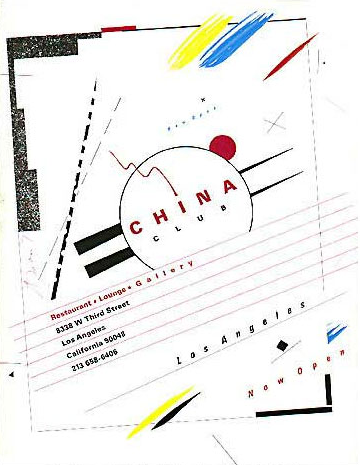
Greiman, A (USA 1980) Nightclub/ Advertisement
http://gds.parkland.edu/gds/!lectures/history/1975/postmodern.html
This example of post modernism uses traits from other artists work rather than designing from scratch. It uses a similar style to Weingart and even Kandinsky.
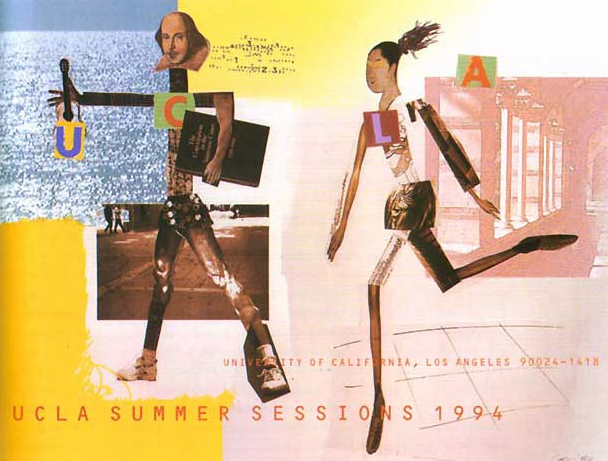
Coy, J (USA 1994) poster
http://gds.parkland.edu/gds/!lectures/history/1975/postmodern.html
The use of collage in this poster, using well recognised faces makes it more appealing and it also makes it witty, which was part of the post modern design. The use of collage was also a new way of working, unlike traditional methods such as painting.
Monday, 7 February 2011
Avant Garde...
Avant Garde was an Art and design style that's purpose was to be progressive and inovative. Avant garde was quirky and original, in a way it mocked the elitism of art and challenged the conventional assumptions of what art is. It was very anti- conventional and anti- elitis.
Now a days the term avant garde has been dispositioned and it is slightly weird in what people call avant garde today.
To be avant garde one must be ahead of society and outside of it, to be able to become a creative genius and inovative.
Avant Garde is a French military term meaning cutting edge/ political and aesthetic.
I have found two pieces of Avant Garde Graphic design:


The two images are proposed pieces of avant garde graphic design, they aim to be inovative and striking. Both images are from the Adbusters website. The top image shows a woman breast feeding a branded baby. Adbusters purpose is to be very anti- consumerist and the ad above is doing this in a very avant garde way. They have branded the baby to show that it has already been pumped with consumerism. Its a spoof ad that is trying to be progressive by going against society and representing their ad in a controversial way.
The second as is also by Adbusters, it shows a rather large man's stomach, its pretty much saying that to be free means to be fat. The man had the freedom of food and by that he has consumed too much and became grosly obese. Again they use a very striking technique to get their point across. They have tryed to challenge the way in which consumerist advertisment is protrayed. Their work is more grounded, aggressive and real. It is showing it as it is, not in an elitis way. I think this is why avant garde is so important when done in the right way.
It is to be real and not show fantacies, to be out there and to be almost better than the world but in an anti- elitis way. As a society we have always known art to be for the rich and fortunate. Avant garde allows the lower classes to enjoy art too.
Subscribe to:
Posts (Atom)